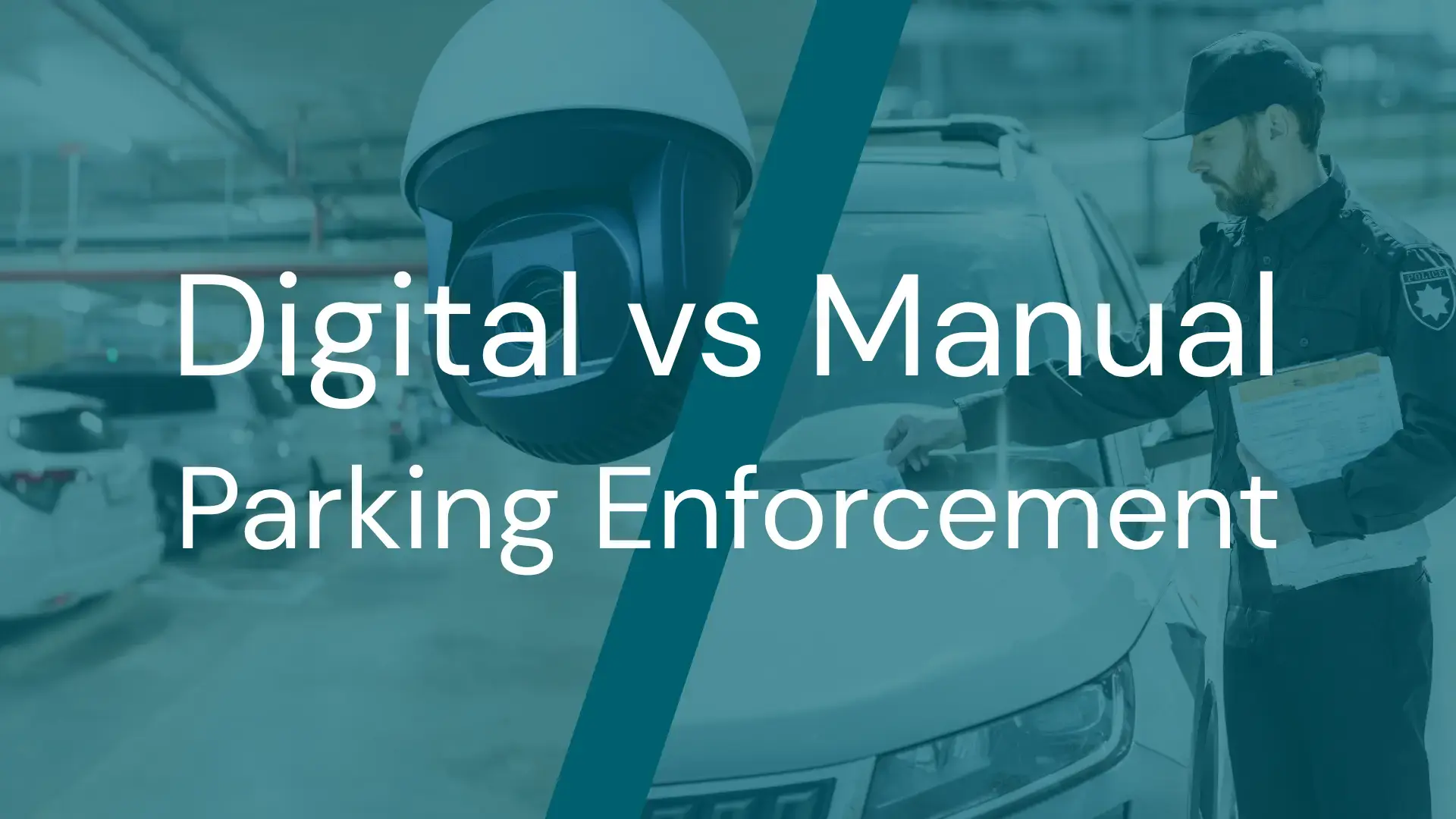
Digital vs Manual Parking Enforcement
With manual parking enforcement, parking attendants walk around and check the cars. Today, this is usually done by the attendant scanning the registration number with a handheld device or mobile phone. With digital parking enforcement, ANPR cameras take over that process. They register every car that drives in and out, and no one needs to walk around checking for tickets or permits. Here, we explain the difference and when parking attendants are still needed.

How does enforcement with parking attendants work?
A parking attendant walks around the facility and checks that every car has paid or has a permit. Drivers show this with a parking disc, a ticket in the windscreen or by starting the parking session in an app. Today, most attendants scan the registration number and see straight away on their handheld device or mobile phone whether the car is allowed to park there. If payment or a permit is missing, the driver may receive a parking fine.
We work with parking enforcement companies. Their attendants can see whether a car has an active permit, even where there are no cameras. But the checks are still only made manually, during the attendant’s rounds. What happens between rounds goes unseen.
How does parking enforcement with ANPR work?
With ANPR, the cameras handle the checks. They register every car at the entrance and exit, and the system immediately sees whether the car has a permit. If the car has no permit, a visitor session starts based on the visitor rate you have chosen. Visitors pay in an app or via a QR code, and only for the time the car is parked.
ANPR works in both garages and surface car parks. What is needed is a clear entrance and exit where the cameras can be placed.
Read more about what ANPR is and how it works step by step, from entrance to exit.
What is the difference between parking attendants and cameras?
The main difference is that attendants carry out spot checks, while the cameras register every car, all the time.
- How checks are carried out: the attendant looks at the ticket or scans the registration number. With ANPR, cameras register every car at the entrance and exit.
- How often: the attendant checks when doing their rounds. The cameras check all the time.
- Visitor payment: with attendants, visitors register their own parking with a ticket or in an app. With ANPR, parking starts and ends automatically.
- Contract customers who stay past their time: with attendants, the customer may receive a parking fine. With ANPR, the extra time is charged at the visitor rate.
- What you know about occupancy: with attendants, you only see what the attendant sees on their rounds. With ANPR, you see when every car is parked, hour by hour.
- What attendants are needed for: without cameras, all checks. With ANPR, keeping order, for example dealing with incorrect parking.
Read about the benefits of ANPR cameras.
How do the checks differ for contract customers and visitors?
With ANPR, contract customers’ cars are recognised and checked in automatically, and visitors are charged for the time they are parked according to the rate that applies at that time. With manual enforcement, it is instead the attendant who has to keep track of who may park where and when, which increases the risk of errors.
Read when free flow parking is a good fit.
What do you learn about your facility?
With ANPR, you can see how your facility is actually used, both in the moment and over time. That is something attendants cannot give you.
Without cameras, you know how many permits you have sold. But a monthly permit usually applies around the clock and says nothing about when the customer actually parks. The cameras show exactly when each car is parked. Many property owners are surprised by how uneven occupancy is, for example in the evenings.
The data becomes a basis for decisions. You can see whether there is room to sell more permits or offer new types of permits. If the garage is half empty at certain times, you can market it more. You can also adjust prices and times to how the spaces are used, for example by letting offices use them during the day and residents in the evening. That way, more spaces can be used without building new ones.
Read how the data is used to increase revenue.
Are parking attendants needed with ANPR?
Yes, but not to check payments. Attendants might still be needed to keep order, for example when someone parks in a disabled space or a loading zone. They then usually only come occasionally, or when tenants report a problem. Cameras and attendants therefore complement each other.
“The cost of enforcement usually decreases by 90–95% compared with having attendants on site once or several times a day for routine checks,” says Oskar Ekman, Head of Product at Mobility46.
When are parking attendants a better choice than cameras?
If all spaces are reserved and every customer has their own space, ANPR offers little benefit. The cameras can see that a car with a permit has entered, but not whether it is parked in the right space. That is where attendants are needed to check the spaces.
ANPR makes the biggest difference where several customers share the spaces, for example where both contract customers and visitors park. What ANPR can give you in a facility with reserved spaces is data on actual occupancy, and on whether unreserved spaces would be a more profitable choice.
What do property owners consider before switching?
The most common concerns are misuse, whether the cameras read plates correctly and whether revenue will be lost.
Can someone misuse the system?
The cameras monitor the facility all the time. An attendant only sees what happens during their round. With zones, you can also control who may park where and when. And because every entry and exit is registered, it is possible to see what has happened retrospectively.
How accurate are the cameras?
At our ANPR facilities, the accuracy is 97% on average. Because the cameras register every car, the checks are more consistent than spot checks. If a camera cannot read a number plate fully, the system flags it and the images are sent for manual review.
Will we lose revenue?
Usually, the data is the biggest gain with ANPR, not the lower cost of attendants. When you can see how the spaces are used, you can fill more of them and increase revenue from the same area.
Read how ANPR affects profitability.
Want to see how digital parking enforcement could work in your facility? Read more about ANPR46.

Want to know more about our camera-based parking system?
With ANPR46, you gain full control over both contract customers and visitors — while reducing administration, improving the customer experience and maximizing occupancy in your parking facilities.