Revenue Optimization with ANPR: The Tools, the Data, and the Impact
Revenue optimization with ANPR means using the camera data to see when spaces are actually used, and then selling parking based on that. A garage can be fully rented out and still stand half empty for large parts of the day. In the webinar, Sofia Fredlund and Pelle Sjögren show how to find the empty hours and how far you can overbook.


Watch the full webinar
Sofia Fredlund, Head of Sales & Marketing, has worked with ANPR for many years and has helped set up facilities of all sizes. Together with Pelle Sjögren, co-founder of Mobility46, she shows how ANPR is used to increase revenue. The webinar is in Swedish and runs for about 40 minutes.
What the webinar covers
- Why ANPR is relevant now
- Statistics as a business tool
- How far you can overbook
- How ANPR works for different target groups
- How parking becomes easier for drivers
- Customer example: how Falu P increased revenue by 24% through better utilisation
- What it means for you as an operator or property owner
Why ANPR turns parking into a business
For a long time, parking has been something that just needs to work. With ANPR, it becomes a business you can manage in detail. The cameras show who parks, when they arrive and how long they stay. With that information, you can shape your offers around how the facility is actually used.
After coin-operated machines came apps and digital permits. ANPR is the next step. The cameras have become cheaper, and most people today want to pay for parking digitally, preferably fully automatically. That is why the technology suits more facilities than before. ANPR is often associated with shopping centres and high traffic, but size is not what matters. It works just as well in smaller garages and surface car parks, indoors as well as outdoors.
Read more about what ANPR is and how it works.
Why are spaces empty when everything is rented out?
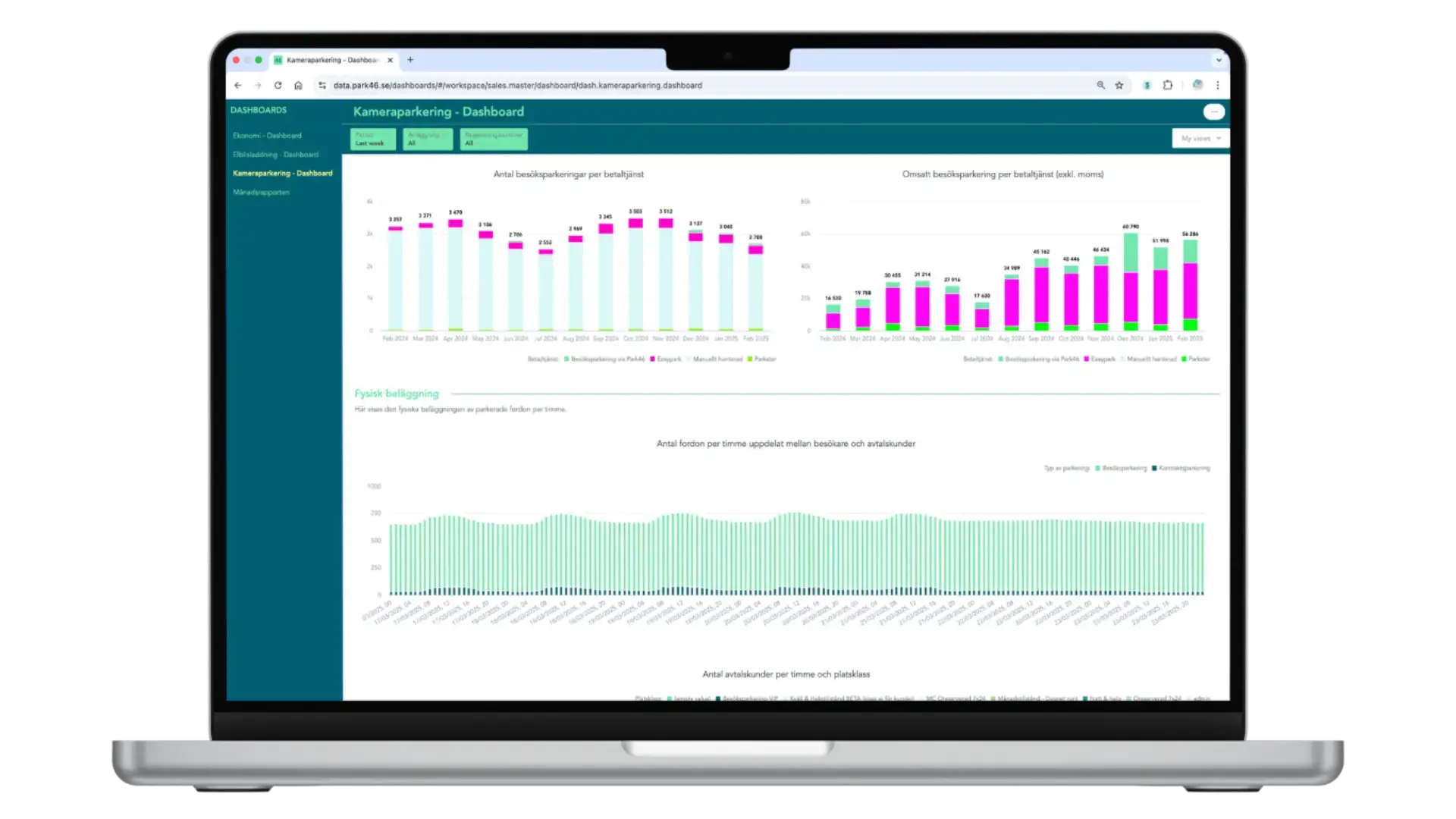
A sold parking permit does not mean the space is used. That gap is exactly what ANPR data shows. The cameras register how many vehicles are in the facility every hour, whether they are contract customers or visitors, and how long they stay. You can also see which payment apps visitors use.
The webinar shows a garage that has sold as many permits as there are spaces. Even so, it is never full. In that case, you can keep selling permits without anyone being left without a space.
Another common pattern is a garage that is full on weekdays between 7 am and 6 pm and almost empty in the evenings and at weekends. There, revenue can in some cases almost double, if you find customers for evenings and weekends. These could be residents or visitors to businesses nearby.
Without cameras, this is hard to see. It takes manual counts and a lot of guesswork. With the data, you can instead test whether you really need to build more parking or whether it is enough to make better use of what you have.
How far can you overbook?
As far as the facility can actually handle, and that is exactly what ANPR data shows. The key is to move from reserved spaces to unreserved permits.
A reserved space gives a customer the right to park there around the clock, even when the space is empty. It stands empty even if the customer is away for a month. With unreserved permits, you can instead sell permits for different times, such as day, evening or around the clock. You can then sell more permits than there are spaces, as long as the data shows there is room. It is the data that lets you overbook without the garage becoming crowded or chaotic.
If a contract customer stays beyond their permitted time, the cameras can start a visitor parking session automatically, if you choose to set it up that way. The customer does not need to move the car, and you get paid for the extra time. We cover how contracts and visits can be combined in the webinar How to develop your parking business with ANPR.
Calculation example: 100 spaces
In the calculation example, revenue comes to SEK 1,545,600 per year with permits, compared with SEK 960,000 with reserved spaces. That is SEK 585,600 more, or 61%. The extra time assumes that each daytime and evening permit is used six minutes beyond its permitted time every day.
The example is simplified, and the result depends on how your facility is used. That is why we always calculate per facility. But when a facility switches to unreserved permits and is rented out according to actual use, revenue usually increases.
ANPR for different target groups
ANPR suits almost any type of business. It is most useful where several target groups share the same space. A common example is an office car park used on weekdays between 7 am and 6 pm, which is filled with residents or visitors the rest of the time.
- Office garages. The cameras confirm that the vehicles driving in are authorised. A company with 30 employees can share 10 spaces, since everyone is rarely there at the same time. A screen at the entrance shows when all spaces are taken. If there are free spaces in the garage, others can park as paying visitors.
- Residential parking. Only residents can get in, and you can control how many spaces each household gets. There can also be spaces for residents’ guests.
- Shops and gyms. The business can offer its customers free parking. The customer enters their registration number on a tablet and gets, for example, two free hours, while other visitors pay. Either the business pays the property owner for the free hours, or the property owner covers them.
- Hotels. Guests drive in without having to do anything. Parking can be paid as a lump sum or by the hour. Free hours can be offered here too.
- Multi-storey car parks. The cameras can control who parks where. Contract customers can, for example, park at the top and visitors closest to the entrance. The facility can also be divided into zones, for example for visitors, contracts, charging and car sharing.
What it is like for drivers
Parking becomes easier for drivers, since the cameras handle check-in and check-out. It is almost impossible to get it wrong. A visit often begins and ends with parking, so smooth parking affects the overall impression.
- Parking starts and stops automatically, and payment is made afterwards.
- The customer only pays for the time they are parked.
- Contract customers are checked in and out automatically.
- No need to display a ticket in the windscreen, since the cameras register the car.
Payment can also be made automatically in the payment app the customer already uses, if they have chosen to.
“There was a property owner where we installed an ANPR system. They had a lot of problems with their parking, a lot of questions and unhappy customers getting in touch all the time. After two weeks they called me and asked: ‘Is the system down? Because we’re not getting any questions.’”
– Sofia Fredlund, Head of Sales & Marketing, Mobility46
The questions about tickets, pay stations and expired contracts disappeared, because the cameras took care of it.
Customer example: the Falu Model
Falu P manages parking for both the municipality and private property owners in Falun, Sweden. For five years, they have worked according to what is known as the Falu Model and measured the results. Revenue has so far increased by 24% through better utilisation, without raising fees or building more spaces. Customer satisfaction has also increased by 102%. The work covers large parts of central Falun, not a single garage, which shows that the approach works in many types of facilities.
The Falu Model has three steps:
- Inventory. What do the parking areas actually look like? Do all types of cars fit, or do some spaces need to be for smaller cars? This is done through physical inspections, drawings and measurements.
- Prioritisation. Which target groups need the space, and when? For example residents, commuters and customers of businesses in the area.
- Packaging offers. Permits that suit each target group, for example for mornings, full days or evenings. The target groups often share the same space, but at different times.
Falu P does not have ANPR in all facilities, and much of the analysis is done manually. With ANPR, the same analysis can be done automatically, since the cameras provide the answers directly.
Watch the webinar on the Falu Model and read the Falu P customer case.
What this means for you
No two facilities are alike. The first step is therefore to understand how your facility is used today. With that knowledge, you can package offers for your target groups and make better use of the space. Sometimes no new parking is needed, and in some cases space can be freed up for something else.
A transition takes time and a clear process, and there are legal questions to consider. We help you with that.
The same thinking applies to charging spaces. A dedicated charging space for every tenant is an expensive solution. Most people do not need to charge every day. When the spaces are shared, one person can charge while another is at work, and the spaces are used more.
Frequently asked questions
How do customers react when we change our parking?
Many property owners worry that customers will be unhappy. A change can be tough at first. But when parking becomes easier and the offer matches customers’ needs, they usually become more satisfied. Falu P measured a 102% increase in customer satisfaction after they started working this way.
What does it take to get started?
The first step is to understand how the facility is used today and who needs it. Then you develop offers for the different target groups. Expect about eight weeks from the decision until the cameras are up and running. Read more about how to get started with ANPR.
What could ANPR achieve in your facility?
Want to know what revenue optimisation could achieve in your facility? Book a free meeting and we will go through your facility with you.
I want to watch the webinar!
Fill out the form and we will contact you shortly.