Buildings Are Becoming Part of the Energy System – And That Changes Everything
Buildings are becoming increasingly important assets in the energy system by combining EV charging, battery storage, solar power and smart energy management. For property owners, this creates new opportunities to reduce peak demand, optimize energy use and unlock long-term business value.
.webp)
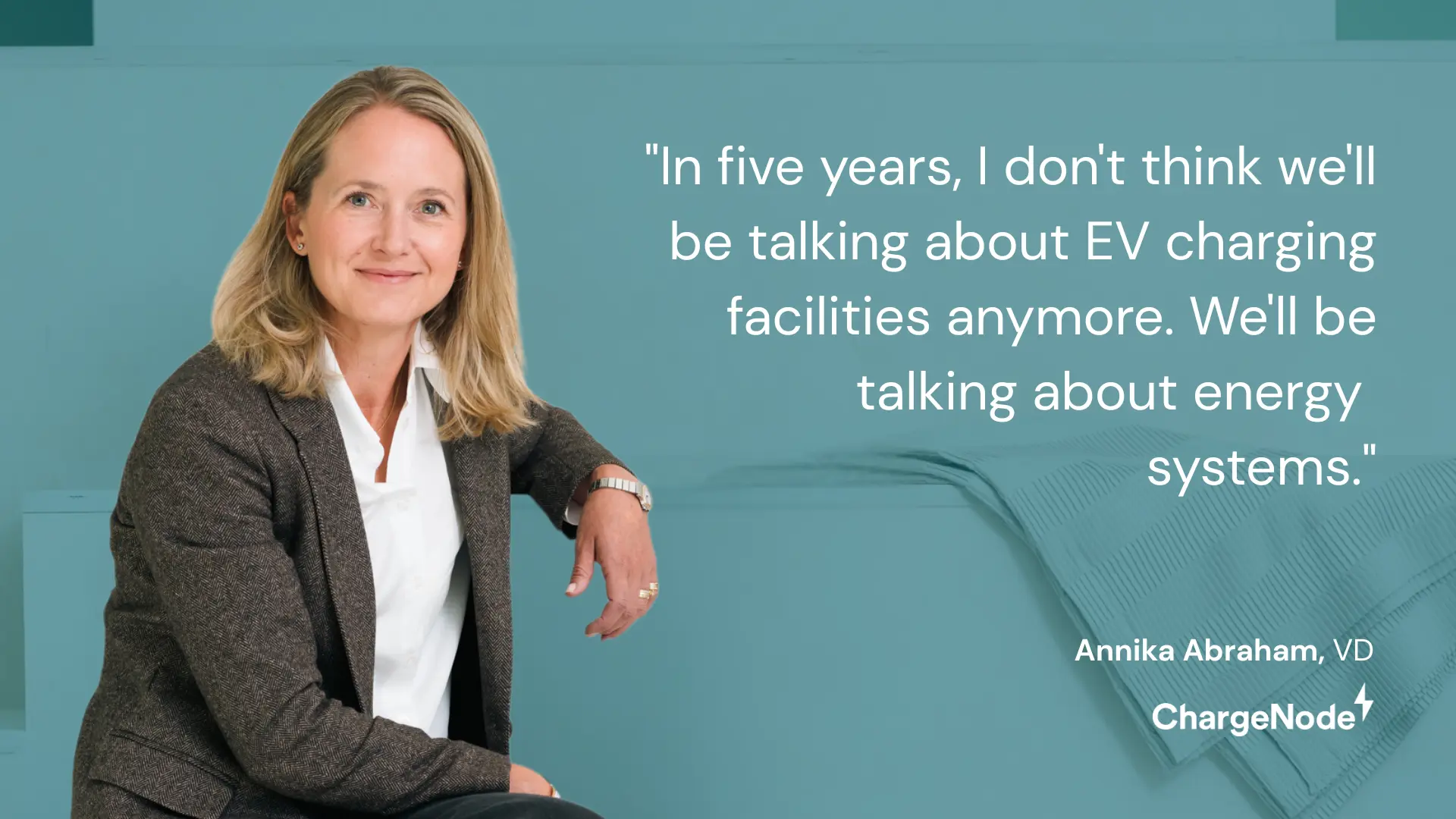
Ahead of Sthlm E-Mobility Summit 2026, we sat down with Annika Abraham, CEO of ChargeNode, to discuss how EV charging, battery storage and Vehicle-to-Grid are reshaping the real estate business – and why a property's future competitiveness may depend on how well it interacts with the energy system.
"A building should be seen as more than a financial asset"
Electrification is often described in terms of more EVs, more charging points and growing electricity demand. For those who own and manage real estate, however, the conversation has shifted. The most pressing questions today are rarely about the charging hardware itself. Instead, they revolve around grid capacity, flexibility and how buildings can operate within an energy system that is evolving faster than it has in decades.
This is the shift Annika wants to highlight.
Since joining ChargeNode – first as CFO and now as CEO – she has witnessed how customer conversations have evolved alongside the market. With a background in finance and high-growth technology companies, she naturally bridges technology, business strategy and long-term investment decisions. That perspective is reflected in the way she talks about electrification. The discussion rarely centers on products. Instead, she returns to a much bigger question: what role will buildings play in tomorrow's energy system?
That question also forms the foundation of her keynote at Sthlm E-Mobility Summit 2026, The Building as a Power Plant – How Charging Infrastructure Becomes Real Estate's Next Revenue Stream.
"A building should not only be viewed as a financial asset. It is also a technical asset that can contribute to energy optimization and balancing the energy system."
From Charging Stations to Strategic Infrastructure
When ChargeNode was founded, customer meetings usually started in much the same way. The discussions focused on which charging stations to install, how many charging points were needed and how the installation should be designed.
Today, the conversation starts somewhere entirely different.
Property owners want to understand how charging infrastructure affects the building as a whole. How it interacts with solar panels and battery storage. How it impacts available power capacity. And perhaps most importantly, whether today's investments will remain relevant as the energy system evolves over the next ten or fifteen years.
For Annika, this is clear evidence that the market has matured.
Sweden Has Plenty of Energy – Power Capacity Is the Real Bottleneck
At the same time, another concept has become increasingly important: available power capacity.
The distinction between energy and power may sound technical, but it has become one of the defining challenges for many real estate projects. Energy describes the total amount of electricity used over time, while power refers to how much electricity can be delivered at any given moment. This means a building may have enough electricity overall while still lacking sufficient capacity when several systems require power simultaneously.
Annika describes a project involving a new Volvo Cars office where development stalled because the available grid capacity was insufficient. Rather than upgrading the grid connection, the solution was to rethink how energy was used. By combining battery storage, on-site renewable generation and intelligent EV charging management, the project's peak power demand was reduced enough for construction to move forward.
"Many people still believe they need a larger grid connection to install EV charging. In reality, with smart energy management, that's rarely necessary."
Buildings Are Becoming Active Participants in the Energy System
Buildings are taking on a new role. They are no longer simply places where people live, work or park their vehicles. Increasingly, they are becoming active assets within an energy system that requires far greater flexibility than ever before.
This is why the conversation around EV charging has changed so rapidly. The focus has shifted from hardware to software, from installation to energy management, and from individual charging points to the building's energy system as a whole.
That shift also changes the underlying business case. Instead of asking which single investment delivers the highest return, property owners increasingly need to consider how different technical systems can work together to create long-term flexibility.
According to Annika, that flexibility will become one of the most valuable assets a building can have.
"It will become expensive not to be part of this transition. The earlier you understand how the energy system is changing, the better prepared you'll be for the future."
Why Property Owners Need Control of Their Energy
One issue that Annika highlights as increasingly important is who actually controls the building's energy.
Today, many property owners allow individual tenants or businesses to hold their own electricity contracts. That model works as long as power capacity is plentiful. Once it becomes constrained, the situation changes.
If the property owner instead controls the main electricity connection and the available power capacity, it becomes possible to prioritize between different loads, shift electricity consumption throughout the day and optimize the building's energy resources far more effectively.
"Whoever controls the main electricity meter will also be in a much stronger position to manage and optimize the building going forward."
It may not be the most obvious investment in the electrification journey, but in the long run it could prove to be one of the most important.
Vehicle-to-Grid (V2G): When Will the Technology Reach Scale?
Vehicle-to-Grid, or V2G, is often described as one of the key building blocks of the future energy system. The vision is compelling: electric vehicles that not only draw electricity from the grid but can also return it when demand peaks.
The technology already exists. The real question is how quickly the rest of the market will catch up.
"I believe infrastructure will develop faster than the vehicle fleet itself."
According to Annika, charging infrastructure is not the primary limitation today. The greater challenge lies in the fact that vehicle manufacturers are progressing at different speeds, technical standards are still evolving, and the vehicle fleet is replaced far more slowly than charging infrastructure.
That does not mean progress has stalled.
Across Sweden, property owners, utilities and technology companies are already collaborating in pilot projects to explore howV2G works in practice. ChargeNode is participating in one such project, integrating EV charging, battery storage, energy management and local renewable generation into a single system.
Technology, however, is only part of the equation. Equally important are the questions surrounding future business models:
- How much energy can a vehicle provide without affecting the driver's needs?
- How should that energy be priced?
- Who carries responsibility if conditions change during the day?
- How will taxation, contracts and regulation evolve when electricity begins flowing between a growing number of market participants?
These are precisely the questions pilot projects are designed to answer. They allow the industry not only to validate the technology but also to develop the business models that will be needed before large-scale deployment becomes possible.
"In Five Years We Won't Be Talking About Charging Facilities"
When the conversation turns to the future, Annika doesn't hesitate.
"In five years, I don't think we'll be talking about EV charging facilities anymore. We'll be talking about energy systems."
Perhaps that is the most significant shift of all.
Charging infrastructure will remain essential, but it will no longer be viewed as a stand-alone investment. Instead, it will become an integrated part of how buildings produce, store, use and share energy. That also changes the way investment decisions are made.
Today, energy management often requires specialist expertise. Annika believes much of that complexity will eventually be handled by intelligent systems capable of automatically optimizing energyuse based on each building's unique conditions.
Property owners won't need to understand every technical detail. But they will need to understand where the market is heading.
The decisions made today about charging infrastructure, energy management and digital infrastructure will shape what buildings are capable of achieving five or ten years from now.
Hear Annika Abraham at Sthlm E-Mobility Summit 2026
How will the real estate business change as EV charging, battery storage, smart energy management and future Vehicle-to-Grid solutions converge? Which investments will create lasting value, and how can property owners prepare for the next phase of electrification?
On 8 October, Annika Abraham will explore these questions in her keynote:
"The Building as a Power Plant – How Charging Infrastructure Becomes Real Estate's Next Revenue Stream" at Sthlm E-Mobility Summit 2026.
If the first chapter of electrification was about deploying charging infrastructure, the next chapter is considerably bigger.
It is about how buildings become active participants in tomorrow's energy system.
"In five years, I don't think we'll be talking about EV charging facilities anymore. We'll be talking about energy systems."
.webp)