.webp)
Ahead of Sthlm E-Mobility Summit 2026, we spoke to Duncan Licence, Head of Automotive & Data at Arrive, about why the future of parking depends just as much on data as it does on physical infrastructure – and what that means for property owners, cities and parking operators.
From square metres to information
According to Duncan, the biggest shift is not necessarily happening in the physical parking facility itself. It is happening in the information surrounding it.
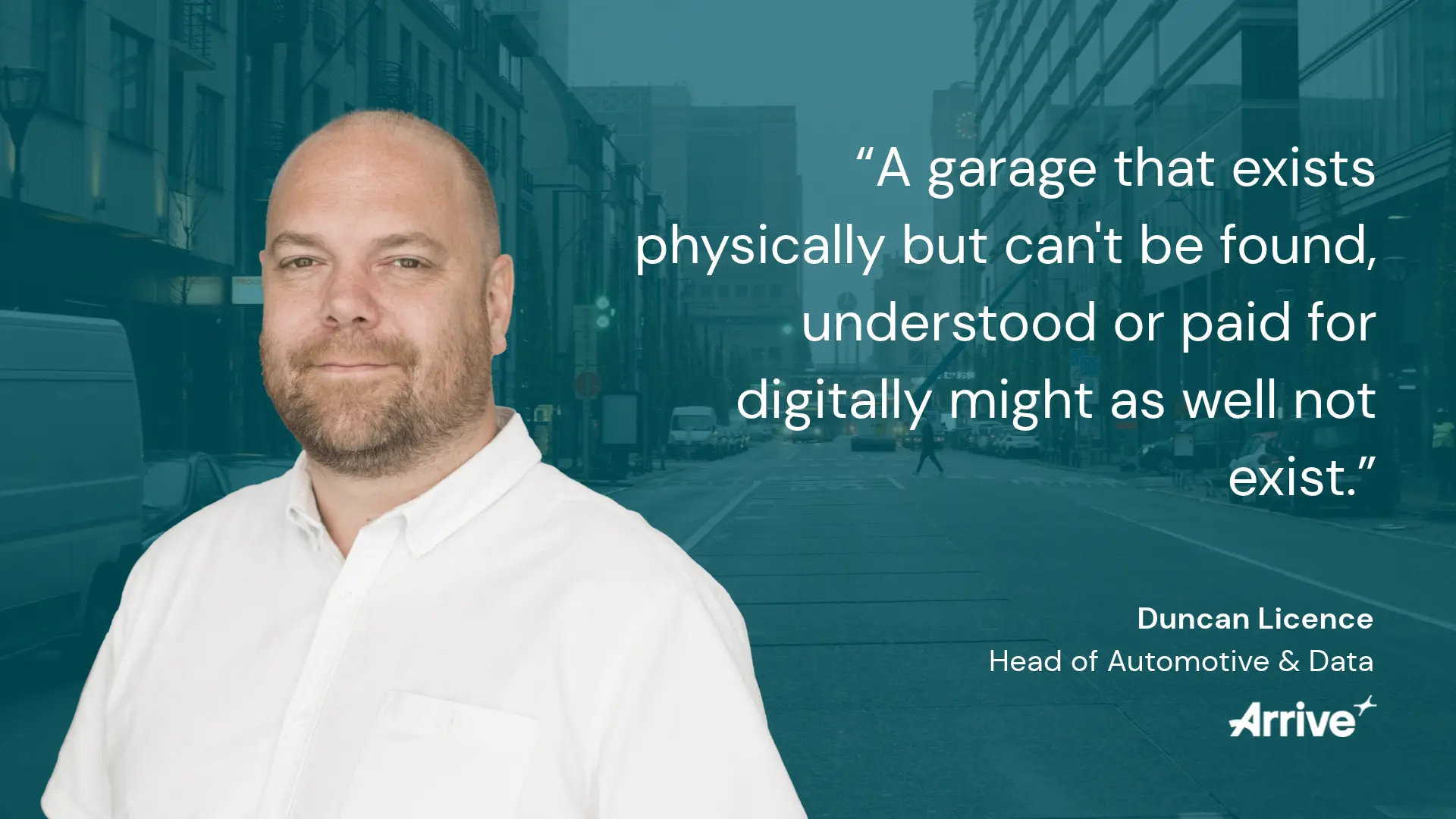
“A garage that exists physically but can't be found, understood or paid for digitally might as well not exist.”
Accurate, up-to-date and precisely geo-located data is becoming essential for helping drivers find parking and charging, understand the rules and complete payments through their phones or vehicle infotainment systems.
When that information is missing or incorrect, the consequences affect both sides of the parking experience: drivers face friction, longer journeys and potentially even fines, while operators risk lower utilisation and lost revenue.
The parking space needs to speak the language of the vehicle
This becomes even more important as vehicles become increasingly connected and, eventually, autonomous.
Today, a driver can read a sign and interpret the rules – even if they sometimes get them wrong. A connected or autonomous vehicle needs something different: clear, structured and machine-readable information.
Is parking permitted? For which vehicle? For how long? At what price? Is charging available? How does the vehicle enter? Where does it wait? How does it pay?
For Duncan, this requires a fundamental shift in how parking assets are viewed:
“Operators have to stop thinking of their asset as a space with a sign on it, and start thinking of it as a space with an API.”
The parking facilities that can communicate in that language will be the ones that remain visible and accessible to the next generation of vehicles.
Different problems – one underlying challenge
At Sthlm E-Mobility Summit, Duncan will explore what this transition means for the future of parking, mobility and the cities around us.
And there is one idea in particular that he wants attendees to take away:
“I want people to stop seeing the parking fine, the empty garage and the undiscovered charger as three separate problems. They're the same problem wearing different costumes: the right information didn't reach the right party at the right moment.”
Thinking of parking as digital infrastructure changes the conversation. Better information can create a smoother experience for drivers, improve utilisation for operators and prepare parking assets for an increasingly connected and autonomous mobility ecosystem.
Hear more from Duncan Licence at Sthlm E-Mobility Summit 2026 on 8 October in Stockholm.
“I want people to stop seeing the parking fine, the empty garage and the undiscovered charger as three separate problems. They're the same problem wearing different costumes: the right information didn't reach the right party at the right moment.”