When the Customer Becomes a Key Player in the Electricity System
Electrification is changing more than what moves on our roads. It is also changing how the electricity system needs to function. As vehicles, buildings and customers become controllable resources, part of the electricity system’s capability is moving closer to the user. For property owners, this makes charging a much bigger issue than the number of charge points. It becomes a question of power capacity, flexibility, data, energy markets and how buildings can contribute to an electricity system where demand and production need to interact more closely than before.
.webp)
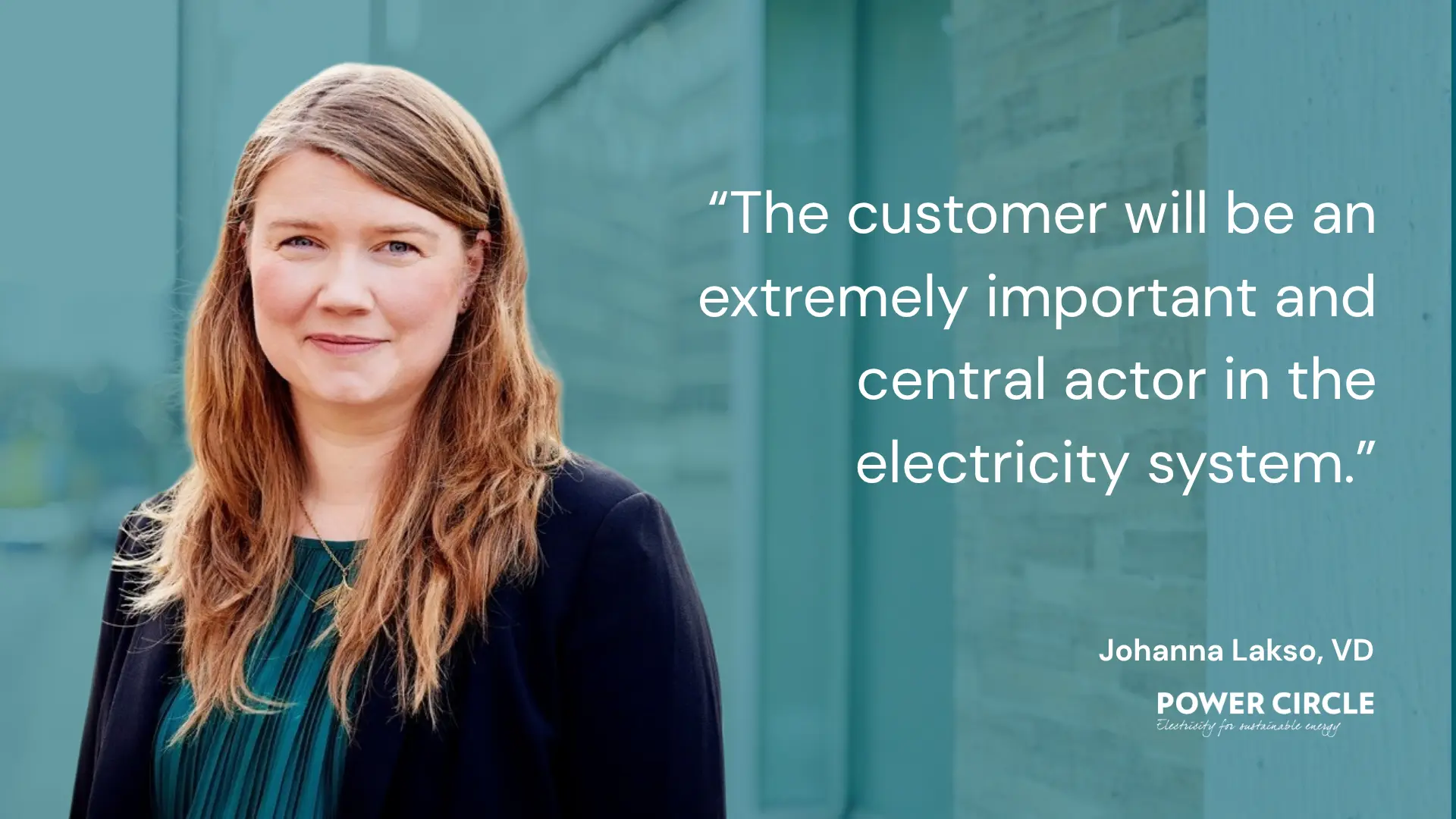
Ahead of Sthlm E-Mobility Summit 2026, taking place on 8 October at Posthuset in Stockholm, we met with Johanna Lakso, CEO of Power Circle, for a conversation about the next phase of the electric vehicle market, the future electricity system and why property owners need to understand their new role.
“I will talk about how electrification is progressing in society, particularly in the transport sector, and how vehicles can fit in as flexibility resources in the electricity system of the future,” says Johanna Lakso.
She describes an electricity system where customers are no longer merely recipients of electricity. They become actors who can influence when electricity is used, how power peaks are managed and which resources can be released locally.
Power Circle’s new forecast for the electric vehicle market lends weight to that picture. In the main scenario, the forecast shows that Sweden reaches one million electric cars on the road in 2029 and two million in 2033. The same scenario puts electric cars at 72.3 percent of new car sales in 2029 and 97.6 percent in 2033.
When the vehicle fleet grows at that pace, charging becomes part of everyday operations in the electricity system. The question is not only where cars will be charged, but how charging will be managed.
An electricity system built for another era
The Swedish electricity system has historically been built around large production facilities, clearly defined roles and a flow where electricity is produced centrally and consumed by customers. That model is now being challenged as more resources move closer to the user: solar panels, batteries, electric vehicles, charging infrastructure and controllable loads.
“The major change is that the electricity system is moving towards more decentralised resources. It is a major shift from how the system has historically been operated, with a small number of central facilities,” says Johanna Lakso.
She sees electricity users as a strong driving force behind the change. Companies want to reduce their emissions. Industry is electrifying. The transport sector is changing drivetrain. Properties are facing new requirements for charging, local production and energy performance.
As resources become more numerous, more local and more variable, the system also needs to be managed in new ways. Johanna points to the need for more digitalisation, coordination and market-based solutions.
This is already visible in the electricity grids. Local flexibility markets are being tested, grid owners are building new capabilities and regulation is moving towards new forms of demand-side flexibility, conditional agreements and tariffs. Johanna also highlights a new network code for demand-side flexibility as a change with major relevance for how customers and grid owners can work together.
Grid capacity shortages do not have the same acute media presence as they did in 2019, but Johanna argues that it would be wrong to interpret that as the issue being solved. Grid owners now have better planning data and more local tools, but the next wave of electrification could quickly sharpen the situation.
“When the major ramp-up of heavy vehicles and industry arrives, we will quickly return to a situation where things become challenging. Then we need a proper toolbox so that we do not slow down the transition,” she says.
That toolbox is not only about new power lines. The grid needs to be expanded, but existing capacity also needs to be used better. Power demand must be managed. Loads must be shifted. Customers must be able to contribute.
When charging meets the property
For property owners, the major system change becomes tangible in everyday operations. Tenants want to charge at home. Employers want to offer charging at work. Parking companies gain a new role in the infrastructure. Logistics operators need to electrify vehicles at depots. Municipalities and housing companies need to meet residents’ expectations without creating new bottlenecks.
Power Circle’s forecast shows why the property sector becomes crucial. According to the report, studies show that 70–80 percent of charging takes place at home or at work, while just under half of Sweden’s population lives in multi-family housing without guaranteed access to charging.
This is where charging becomes a power capacity issue. Many vehicles charging at the same time can create high peaks over short periods. This affects grid subscriptions, costs and the ability to use a property efficiently.
“For property owners, charging can create large power peaks. But with smart solutions, it can also become an asset and a resource,” says Johanna Lakso.
Managed correctly, charging can interact with the building’s other energy use, local solar power, batteries, ventilation and thermal storage. In the longer term, electric vehicles themselves can become part of the flexibility through Vehicle-to-Grid and Vehicle-to-Home. Johanna describes how vehicles can be used as batteries connected to the property.
For property owners, the work does not begin with the most advanced technology. It begins with knowledge of the asset itself.
“The first step is to understand your own data. What opportunities do we have? How do our systems work together? Can they be optimised together?” says Johanna Lakso.
Those who do not understand their power peaks risk investing reactively. Those who understand their data can plan for smart charging, dimension correctly, manage according to local conditions and prepare for a market where flexibility has a clearer value.
The next phase requires more than forecasts
Johanna Lakso describes a development where electrification requires more than additional charge points and more electricity production. It requires new forms of interaction between customers, properties, grid owners and markets.
Power Circle’s forecast points in the same direction. The report describes the electric car as part of society’s electrification and notes that the development creates new requirements and opportunities for how the electricity system is built and managed.
Politics matters here, but it is not the only determining factor. Johanna points to Denmark as an example of how long-term policy instruments can influence the pace. According to her, Denmark has gone from around 20 to 80 percent electric cars in new car sales in four years, while Sweden lost momentum after the electric vehicle bonus was withdrawn.
Power Circle’s forecast describes the same difference between the countries: at the beginning of 2026, Denmark was at just over 80 percent electric cars in new car sales, Finland was approaching 50 percent and Sweden ranked lowest in the Nordics.
For property owners, the conclusion is practical. If electrification accelerates, the need for charging, power planning and local management increases. If it slows down, investments, regulation and customer behaviour risk falling out of sync. In both cases, property owners need to understand their role.
Johanna also highlights energy sharing and energy communities as areas where new opportunities are emerging. She describes how collective management of flexibility resources can create greater value than if each household or customer optimises individually.
That picture makes property owners more than recipients of new requirements. They can become part of the solution by managing charging, reducing power peaks, coordinating local production and eventually participating in new forms of flexibility and energy sharing.
This is also what Johanna Lakso wants the audience to take away from her keynote.
“The customer will be an extremely important and central actor in the electricity system of the future,” she says.
For property owners, that role begins with their own data, their own power demand and the decisions made before demand becomes urgent. On 8 October 2026, Johanna Lakso will expand on what this means at Sthlm E-Mobility Summit at Posthuset in Stockholm, where decision-makers from real estate, housing, parking, municipalities, energy and mobility gather to understand the next phase of electrification.
“The customer will be an extremely important and central actor in the electricity system of the future.”